Valle del Cauca offers a unique set of strengths derived from its geographic location, productive development, and infrastructure. According to the latest data, the region accounts for 18% of Colombia’s industrial output and 22% of its agribusiness. It is also home to the country’s leading port, which handles 46% of Colombia’s containerized foreign trade.

The department is rich in biomass, supported by a clean energy matrix and a strong capacity to develop nature-based solutions with minimal environmental impact. This combination of current capabilities and global trends positions Valle del Cauca as an ideal destination for operations aligned with international sustainability standards.
The availability of strategic partners and the advancement of value chains in renewable energy, green chemistry, and the circular economy enable companies operating in the region to move forward toward their carbon neutrality goals.
Electric power is one of the most critical inputs for a wide range of economic activities. The global objective is to increase the share of renewable energy sources, recognized for their lower environmental impact.
Compared to other regions, Valle del Cauca has a greater capacity for clean energy generation. In the department, electricity is primarily produced from:

Valle del Cauca not only has a renewable energy matrix but also the most diversified in the country. It is furthermore the leading department in biomass-based energy generation, accounting for approximately 94% of the national total.
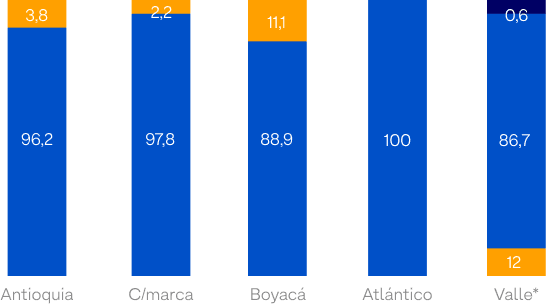
Source: XM – Prepared by the Cali Chamber of Commerce
The production processes of the manufacturing and agribusiness industries generate by-products that can be transformed into new business lines, revenue streams, and innovative alternatives to reduce environmental impact.
Valle del Cauca is home to the country’s leading paper and cardboard recycler and has established capabilities for reusing recycled plastics. Currently, the largest PET packaging supplier has formed a strategic alliance for recycled material sourcing, enabling an increased share of recycled inputs in its processes. This initiative provides industries in food, beauty, personal care, and household products with solutions aligned to global sustainability standards.
Valle del Cauca is Colombia’s third-largest producer of chemical products and the origin of nearly 30% of the country’s exports of cosmetics and personal care. A key input for this industry is surfactants, used in soaps, shampoos, emulsions, and creams.
The surfactant market is highly attractive. According to ProColombia, in 2023 Colombia imported 45,000 tons, while national demand exceeded 150,000 tons. In Latin America, imports surpassed USD 880 million, with Colombia accounting for approximately 10% of this value.
Surfactant production requires two main inputs: ethylene oxide and fatty acids.
Green hydrogen and its derivatives represent a significant opportunity. According to the Power to X (PTX) Potential in Colombia study, promoted by Germany’s Federal Ministry for Economic Affairs and Climate Action, Valle del Cauca is identified as the hub with the greatest potential to develop this industry in the country.
This type of hydrogen is produced through electrolysis, a process that separates hydrogen molecules from water using renewable energy. From it, several key compounds can be derived:

The development of this hub is supported by the availability of biomass and the established business and industrial network in the region, reinforcing Valle del Cauca’s competitiveness as a leading center for green chemistry in Colombia and Latin America.